
 This post is the first in a series where I will share some thoughts following my visit to Uruguay, which took place from 18th-27th August 2018. I was visiting professor at the Universitidad de la Republica, which is the largest and only public university in Montevideo. The visit was centred around delivering a masters level course for teachers, librarians and lecturers on Copyright Literacy and Open Practice, which I taught to an enthusiastic cohort during the evenings of the week of my visit. I was based in the Faculty of Information and Communication and most of the students were working in the day time, so evening classes are quite common in Uruguay. The students had a chance to play the two educational resources that Chris and I have developed, Copyright the Card Game and the Publishing Trap as part of the course. They also planned some engaging approaches to copyright education and considered how concepts such as open practice impact on their work. In this first blog post I will reflect on some of my experiences of teaching the course, and the lessons I’ve learnt which are going to be useful when planning a new module I am teaching at City University starting in October 2018.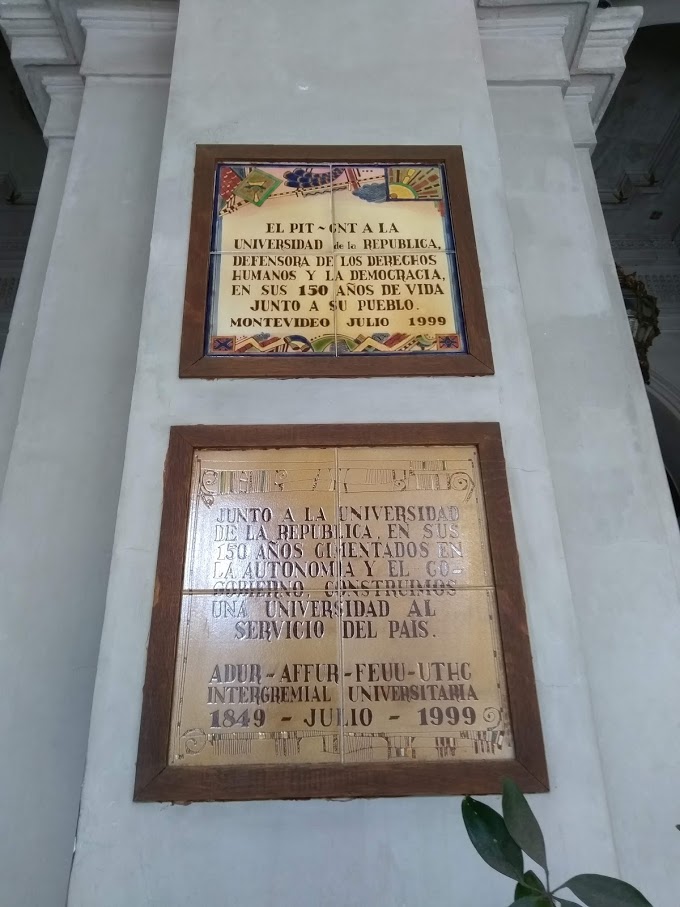
Many things struck me as being different in Uruguay, although also strangely familiar in many way! What was clear is that access to resources, specifically to published content is far more limited in Uruguay, and for that reason it has been one of the key factors driving an interest in open education, open textbooks and more sustainable models of providing students with access to knowledge. Universities are free in Uruguay, students pay no fees and there are no entry requirements. My host Virginia Rodes told me on several occasions they have been practicing open education in Uruguay for nearly 200 years (The University of the Republic was first founded in 1849). Reflecting on what ‘open’ means was an important part of the course and it’s also clear that in Uruguay in particular, open means accessible, for students from all types of backgrounds and particularly for students with disabilities and visual impairments. So there are no entry requirements to attend university in Uruguay, to encourage students from all backgrounds to go on to study further. However as a point of principle, the fact that education up to and including higher education is free for students, is a real contrast to the UK. Those on my programme were surprised to learn that students in the UK paid fees, and could end up severely in debt at the end of their studies. I was constantly asked if the UK government didn’t want students to study at university, based on this policy. And I spent some time reflecting on the UK’s ‘widening participation’ policy and if it actually works.
 I was based in the Faculty of Information and Communication which is a large impressive building, centred around an old church, with a modern exterior, but preserving the historic building in the heart of it. It was a lively place with students studying a whole range of subjects including communication studies, media studies, information and librarianship. Virginia, my host, coordinates the ProEVA which is essentially a teaching, learning and technology centre you would have in a UK university. They have 7 staff but host Moodle and a range of educational technologies (pretty much all open source, including their lecture recording system). Several of the staff also are part of the university’s OER centre (Nucleo REA), which have run an impressive range of interdisciplinary projects over the last few years, also involving staff from the library and across the faculties. It was the project they ran on student access to textbooks that first got me interested in Virginia’s work, which highlighted the problems that a limited budget and really restrictive copyright laws, were having on students in Uruguay.
In the second half of the second day I got students to play the Publishing Trap, which they also really enjoyed. I worked with Patricia Diaz, who is a lawyer, a member of Uruguay’s Copyright Council and another of my host’s during my visit. Patricia and I found much to talk about during the week, such as the finer points of the differences between fair dealing and fair use, we also discovered a shared love of cats! And spent a lot of time communicating in what she called Spanglish, which was where we learnt that more words in Spanish are actually quite similar in English than you might expect. Patricia’s research has examined copyright exceptions in four Latin American countries, partly to highlight the lack of exceptions in the law in Uruguay. She also plans to help translate and adapt the Publishing Trap into Spanish, for use in Uruguay. We had a lot of fun during the game, with one team (playing Brian the microbiologist) deciding to go entirely ‘closed’ in their approach to the game. Unsurprisingly they lost the game! We concluded Brian really didn’t want anyone to know about his research unless they paid him! He was holding out for a big break with a pharmaceutical company which never came!

On the final day which was mainly focused on lesson planning, creative approaches to copyright education, and thinking about strategies for embedding this in your teaching, the groups came up with some really inventive lesson plans based on a number of scenarios I gave them. They were also really good at writing learning outcomes and at the end of the session I discovered critical pedagogies played quite a significant role in the approach to education in Uruguay. Interesting, as I had taken a copy of Friere’s Pedagogy of the Oppressed to read and was well aware he came from Brazil. At the end of the course I set an assignment for the students which they have three weeks to complete – they will be reflecting on their approach to open practice or copyright education and writing either a lesson plan or an action plan to embed aspects of what they learnt into their own teaching. I can’t wait to see what they come up with. It was a fantastic experience to develop a whole course such as this and has made me even more excited about launched my new module at City University on Digital Literacies and Open Practice which starts in mid October. You can take a look at the course blog I’ve set up to get an idea of what this course will cover.

 Copyright Literacy
Just a quick correction, thanks to Alicia Ocaso who is Vice President of the Uruguayan Copyright Council. Patricia Diaz is not actually a member of the Council, although she has advised them based on her research into copyright exceptions in Latin America. More information about the Copyright Council is here: http://www.mec.gub.uy/innovaportal/v/37416/2/mecweb/derecho-de-autor?leftmenuid=3
LikeLike