
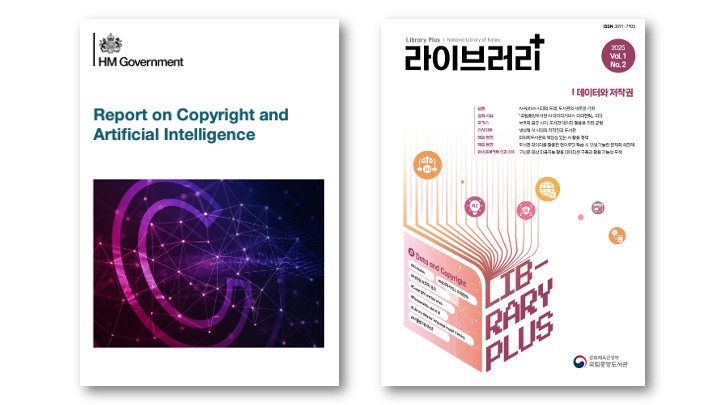
Chris writes: Last week saw the publication of two papers relating to copyright and AI. The first was the hotly awaited UK government impact assessment on Copyright and Artificial Intelligence. The second was a paper I was asked to write for Library Plus – the journal of the National Library of Korea – on copyright and libraries in the age of generative AI.
I wasn’t expecting both reports to be published on the same day, but the fact that they were provided a good opportunity to take stock not just of the public conversation about copyright and AI, but also the implication for those of us working in libraries and related memory institutions.
The UK Government impact assessment relates to the consultation on copyright and AI which was open between December 2024 and February 2025. I won’t attempt to provide an in depth summary of the report, but the key message is that they have decided not to continue with the controversial proposal to create an exception to copyright for AI training with an ‘opt out’ mechanism for rights holders. This is unsurprising given that significant issues with the proposal were raised by almost all respondents to the consultation. For those in the creative industries it appeared to be a green light for tech companies to replace human creativity with machine generated slop. For those in the tech industry, the proposals presented unworkable bureaucratic hurdles to developing AI tools in the UK. The report sets out responses received from the stakeholders whose work is impacted by these issues.
But as set out in the Library Plus paper, the focus on this debate as being essentially a battle between two sides – creative industries in the red corner, big tech in the blue – ignores the fundamental importance of research and memory institutions. It is therefore helpful to see an references to the consultation response from the Libraries and Archives Copyright Alliance (LACA) of which I am a member, and recognition that copyright law needs to support scientific research and scholarship.
There is clearly work for the library sector to do in raising the importance of the profession to this crucial question of how copyright law should operate in the age of generative AI. As my piece points out, libraries are both users of and contributors to generative AI technologies, with our collections and data providing essential fuel for the training of artificial intelligence. I note that we are also one of the most trusted professions, providing information and digital literacy skills support to a large number of diverse communities. It seems clear that the uncertainty around the law as it relates to AI is likely to continue for some time. The opportunity to promote critical thinking and navigate the ethical considerations could arguably be the library profession’s time to advocate for the value of libraries in a world of outdated popular misconceptions. If you’re not sure about whether what this machine is telling you is helpful, might there be some kind of human ‘information professional’ that could help you make sense of it?
This is an exciting if anxiety inducing time to be be working in copyright and libraries. It seems to me that the concept of copyright literacy (basically looking at copyright law from an information literacy perspective) is more important now than ever. I am therefore looking forward to the work I’m leading at the Bodleian Libraries, University of Oxford to establish a copyright literacy programme in line with our strategic objectives (check out my and Jane’s copyright waffle with Richard Ovenden, Bodley’s 25th Librarian if you missed it back in 2023). I’m also very excited to be returning to the LILAC conference in Sheffield next week to chair an all-star panel of copyright specialists and library leaders. Entitled – ‘It’s not legal advice, but is it information literacy’ we will be digging into all the complex richness of balancing innovative thinking and activity with our responsibility to be professional and ethical.
Watch this space for more on copyright and AI with an information literacy spin, and please get in touch if you have any thoughts on either document. We are always interested in guest blog posts so let us know if you have something to say on this or any other topic.

 Copyright Literacy
Hi Chris. This is a timely post. I’m going to be talking about the copyright card game tomorrow in a webinar, and I expect questions about AI to come up. It seems to me that the main answer is that it’s largely up in the air at this point, until more cases get decided or legislation gets passed. I may be quoting you in my presentation. I’m also adding some AI-related scenarios to the game so players can think through and discuss the copyright implications.
LikeLike
Hi Paul, great to hear from you and thanks for the mention. Let’s stay in touch about how we can develop these resources to address people’s questions in the age of generative AI
For those that don’t know Paul Bond created a US version of the copyright card game in 2017. Here’s a link to the blog post he just published:
https://blog.raptnrent.me/2026/03/26/play-the-hand-youre-dealt/
LikeLike