
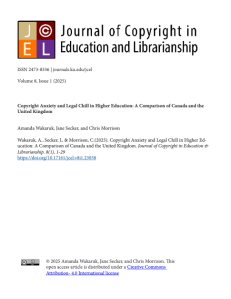
We are delighted to report that our latest research, co-authored with Amanda Wakaruk from the University of Alberta, into copyright anxiety was published earlier this week in the Journal of Copyright in Education and Librarianship. It’s a study of professionals in higher education, comparing Canada and the UK, but also drawing on the 2021 study that surveyed the general public in Canada and the USA. In our recent research we surveyed over 500 people and conducted seven focus groups to understand how copyright impacts on teaching, research, and library services.
There are some fascinating findings and we urge you to read the article in full, but in summary we found:
- Those working in higher education report significantly higher levels of copyright anxiety than those outside the sector. And this anxiety isn’t just a passing concern, it can lead to a legal chill associated with navigating copyright law where fear of infringement stifles innovation and creativity.
- We also found that while those working in higher education claim to be more confused about copyright than the general public, they are actually less fearful about using copyright content.
- There were also some significant differences between the respondents in Canada and the UK, with higher levels of ‘worry’ about copyright in the UK. This was interesting in light of the recent legal action against a Canadian university – perhaps the reality of litigation makes people less anxious about the potential implications compared to those where no recent litigation has taken place?
It’s worth clarifying that the concerns noted by participants were largely associated with legitimate, legally defensible practices in higher education. For example academics may avoid using their first choice of teaching materials due to copyright concerns, compromising their ability to teach in the way they wish. Researchers can also be hampered by copyright concerns, or the time it might take to get permission, leading them to redact content from research outputs such as PhD theses. And librarians who are often tasked with advising on copyright, experience heightened stress and reported offering risk-averse guidance to their colleagues and to students, which can further limit access to resources and ideas.
Our research concluded that by better understanding the emotional and practical toll of copyright anxiety, institutions can begin to develop strategies that empower their employees rather than inhibit them. We are working on a follow up paper that will explore the underlying reasons for copyright anxiety and the strategies that help address it and mitigate legal chill.
And if you want to find out more but your reaction to the the article is TL:DR (too long: didn’t read) we’ve used AI in the form of NotebookLM to create a podcast summarising the article for you! We’re also excited that Amanda has also been reporting on our research findings at IFLA’s World Library and Information Congress in Kazakhstan this week.
This post was amended on 26 August 2025 to clarify wording and avoid a suggestion that the litigation in Canada reduced the level of copyright anxiety and legal chill in the sector

 Copyright Literacy