
…or ‘How you can learn to stop worrying and love copyright’

This guest post was written by Christine Daouti. She presented her game Copyright for Humans at Icepops 2024 and has since updated it following feedback from the delegates. Christine is the copyright support officer at University College London. Previously she worked in open access roles for over 20 years. She has a special interest in creating educational resources on copyright, including the UCL Copyright Essentials online module and the Copyright and your Teaching online module.
Overview
Copyright questions bring out different reactions in people: dread, interest, uncertainty, horror, excitement, humour or – let’s face it – boredom. ‘Copyright for Humans’ is a new card game created for those whose eyes glaze over at the mention of copyright, those who feel nervous when faced with a copyright question, and those who are interested in copyright and want to share their opinions with others.
Drawing from a large pool of questions and an even larger pool of possible answers, you are encouraged to discuss and respond to different copyright scenarios in humorous and creative ways. You may gleefully agree with some copyright decisions (e.g. ‘this is the best idea since the invention of printing!’), pompously condemn others (e.g. ‘this is pure evil’; you may feel uncertain (e.g. ‘I’m not answering this without my lawyer’ or avoid answering altogether (e.g. ‘Frankly, my dear, I don’t give a damn’). The game encourages players to consider different types of answers and learn about copyright in the process.
The spark
Let’s face it: worry and copyright often go together, and this is true even for the most seasoned copyright literacy geeks among us. Take online copyright sessions, for example. How many times have you asked your audience a question or introduced an interactive activity (however mildly, encouragingly, friendlily) only to have people switch off their cameras or leave a session altogether? Or think of a polarised, not-so-well-framed copyright debate (yes, ‘UK Government Copyright and AI consultation’, I’m looking at you): how more emotional can you get? Let alone all the copyright advice we give as part of our roles, which exposes so many diverse approaches, opinions, appetites for risk, assumptions and feelings, both among the people we support and among ourselves.
Playful copyright literacy opportunities have already gone a long way addressing these worries and encouraging people to think about copyright confidently and critically. Think Copyright Dough, the Publishing Trap, the Copyright Escape Room, the whole concept of Icepops, and so many others. It doesn’t matter if you are a copyright novice, a world expert, a bundle of copyright nerves or a suave copyright veteran, in a playful environment you can share our opinions more freely because you know what? We were all children once, we’re still children, really, and things get less intimidating when everyone is playing with unicorn stickers while talking about controlled digital lending.
While I was looking forward to Icepops 2024, I didn’t plan to present anything: just relax, gorge on sweets, meet some lovely people and listen to some interesting copyright insights. However, the conference theme, ‘Copyright and the Human Being’, was too good to pass. The idea was right there: .the things that make us human are also the things that drive our decisions when it comes to copyright, with anxiety probably being the top emotion overall. And it is the very things that are unique to humans (humour and creativity) that can help us overcome this anxiety and start learning for real. What about making a game (loosely inspired by the Cards Against Humanity game) that allows people to give outrageous, over-the-top, very emotional and human answers to copyright questions? This could then be played as a stand-alone or as part of a training session to encourage engagement and debate. Once the idea was there, the game practically wrote itself.
Creating the copyright game.
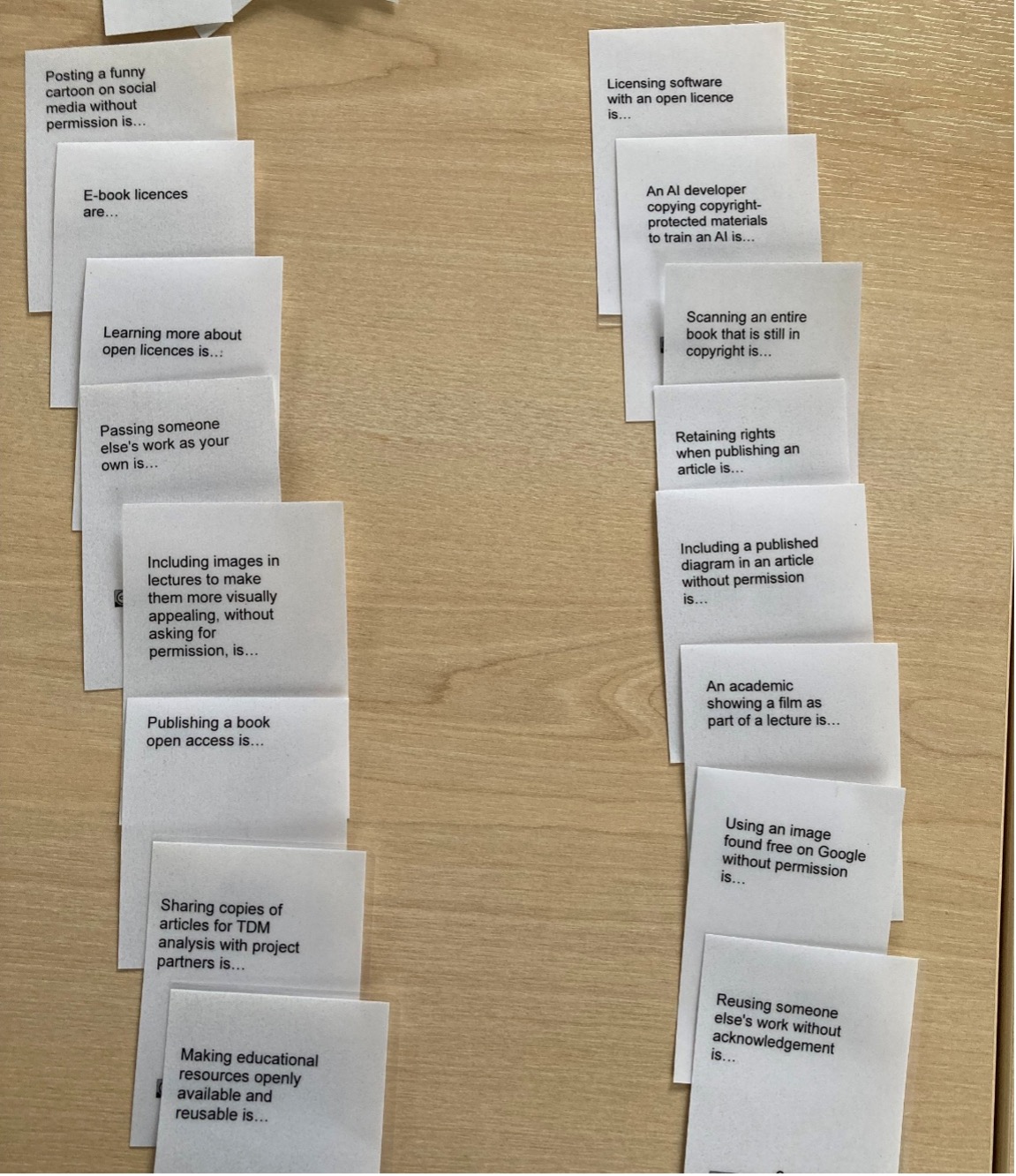
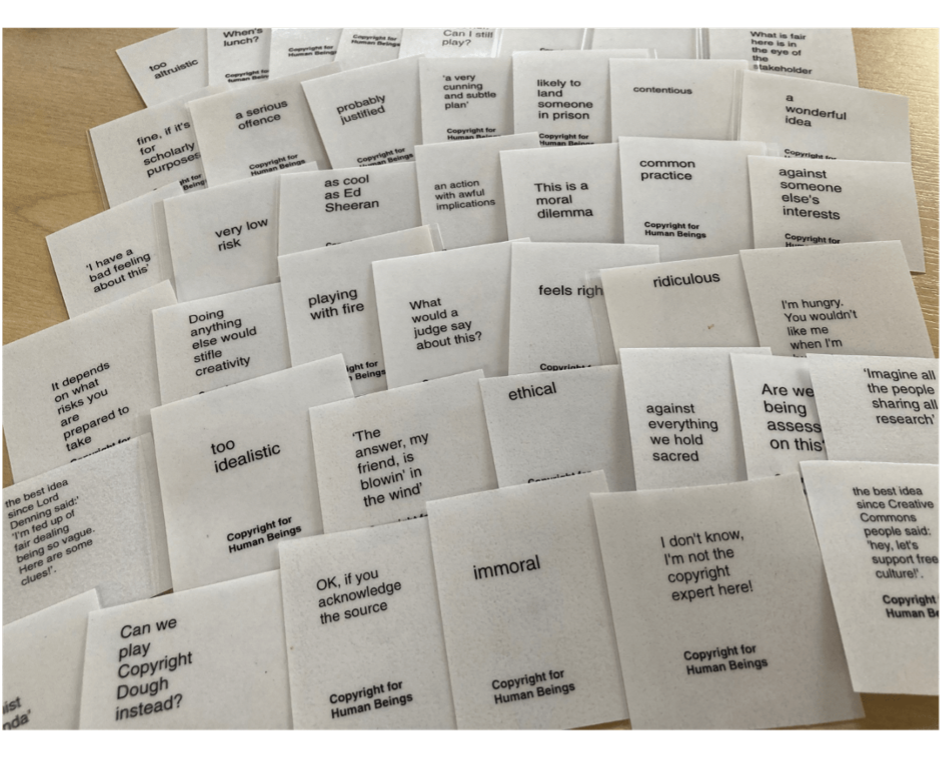
The game consists of 100 questions that relate to copyright and open access/open science scenarios. These were very quick to put together. Think of queries, FAQs, things that come up on LIS-COPYSEEK, on the news etc. The questions are phrased as incomplete sentences, e.g. ‘Including a graph in an article without permission is…’., ‘Open access is…’, ‘Reading a publishing contract before signing it is…’ or ‘Suing Ed Sheeran because his song is too similar to yours is…’. Players draw from a pool of 500 answers to complete the sentence. Some of the answers are positive, e.g. ‘Groovy, baby!’; some are negative, e.g. ‘communist propaganda’ (yes, really, I’ve heard this one about open access); some are neutral/it depends answers, e.g. ‘probably OK under an exception’; and some too vague and avoidant, e.g. ‘The answer, my friend, is blowin’ in the wind’, ‘I’m bored. When’s lunch?’ or ‘Help me, LIS_-COPYSEEK. You’re my only hope’. Players are very strongly encouraged to sing/perform their answers.
I won’t bore you with the logistics e.g. how many players, how many cards per round etc – you can read the instructions. The key point is that a question is read out and each player puts forward an answer. The group then discusses the different answers. The game leader sums up the answers and provides some steer at that point (e.g. referring to a copyright exception, introducing a court case etc). As you will see in the instructions, there are several variations you can play.
While coming up with the materials was quick and fun, making the physical materials was a nightmare. I very seriously underestimated how long it takes to print, laminate and guillotine all those cards. My lovely colleagues at UCL helped and even this wasn’t enough. Even summoning Robespierre (a guillotine pro, I’m told) back from the dead would not be near enough. So if you are using the game, please print only the subsets you need. This is common sense but clearly I don’t have much common sense.

Piloting the game: Icepops, chaos and the importance of common sense
Having produced the cards, the next step was to take them to Leeds for the Icepops conference. I was looking forward to demonstrating the game. I did in fact demonstrate the game and clearly this was successful to a great extent, as people ‘got it’, liked it and offered some very useful suggestions. One of the most useful suggestions was to create subsets for different topics/audiences. This was a very polite way to say: ‘what were you thinking, scattering 600 slippery cards on a small table for a 15-min demo?’. There were cards all over the place. I kept apologising and frantically picking up cards off the floor, the table, people’s coffee cups etc. well into the next session.
Despite people finding the game engaging, this was far from ‘piloting’ the game. Still, I found the session very useful and came back from Icepops determined to make the game more manageable.
After a couple of useful pilots at UCL (where some players demonstrated amazing acting and singing skills), I created sub-sets for the game, refined some of the instructions and proofread the materials, until I was happy with a shareable version.
Sharing the game: ‘I got the (copyright) chills, they’re multiplying…’
Just before I was ready to share the materials publicly, I got a bad case of copyright anxiety. The reason was that I had decided to include a few song lyrics and quotes from books and films in the answer set. Is including song lyrics: (a) a genius idea; (b) the worst idea since Julius Caesar decided to play with matches inside the library of Alexandria; (c) probably defensible or (d) ‘I had the answer to this but ChatGPT ate it;?
What do you think?
Overall I was inclined to include the third party materials (with acknowledgement, of course) but I also sought advice from the wider copyright community. Thankfully this was discussed at the Icepops highlights webinar: it was felt that the use of those extracts in the context of the game was justifiable. The general opinion was to include them, acknowledge the sources and clarify that any open licence applied to the game excluded those materials.
The game materials are now available on the Copyright Literacy website. Excluding third-party materials, they are under the Creative Commons Attribution Licence (CC BY 4.0). You are more than encouraged to modify the game, add your own questions and answers, adapt for different audiences etc.
Applications and adaptations of the game
As mentioned, the game can be played in many different ways. Initially designed to play face to face as a card game, it can also be incorporated as a poll in a lecture (we have played this version twice at UCL, with Institute of Education PGRs and with Computer Science Master’s students). This version has the advantage that it speeds up the game, can be embedded into lectures etc., but it is probably a bit too structured: some of the randomness of the answers is lost, as this version is effectively a multiple choice poll.
I would be very interested in working together on an online version. I would also be interested in ways to produce high quality cards (my current version does not look very professional – that guillotine again). If you have any questions, suggestions or would like to work together on this, please contact c.daouti@ucl.ac.uk.
Access the materials (zip file 806kb)
You can access the game instructions, a spreadsheet listing all sets of questions and answers, and two Word files containing all the cards from the link above.
Many thanks to Jane, Chris and all the Icepops 2024 organisers and attendees for the invaluable inspiration and feedback.
Note: parts of this blog post have appeared in the UCL Copyright blog. https://blogs.ucl.ac.uk/copyright/2025/03/18/are-you-a-human-then-ucls-new-copyright-card-game-is-for-you/

 Copyright Literacy
.jpg)