
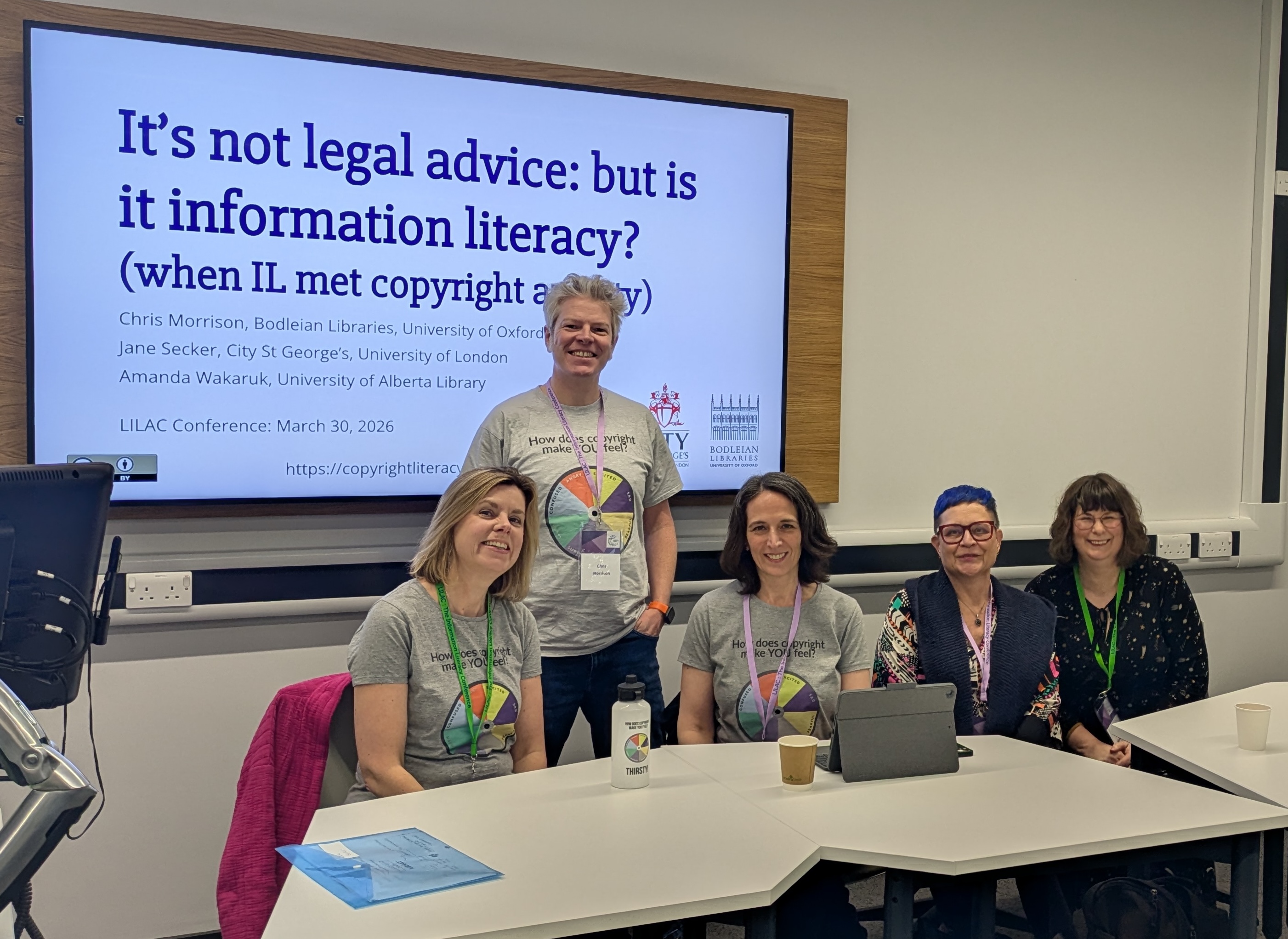
Jane writes: We’ve been in Sheffield this week for LILAC 2026. LILAC is the UK’s information literacy conference and I’ve been part of this community since the first conference in 2005. Last year I was giving a keynote, so this year’s contribution felt a little more low key, but no less fun and impactful I hope.
I was part of a panel discussing whether copyright is part of information literacy (clue – I think it’s a huge part and have done for over 10 years when Chris and I first wrote a blog post for CILIP about this!) However, this time we were sharing some of the findings from the Copyright Anxiety study that Chris and I undertook with Amanda Wakaruk from the University of Alberta, and are in the final stages of writing up. If you haven’t seen it, our first article was published last year in the Journal of Copyright in Education and Librarianship and highlights some of the key findings from the survey data comparing levels of copyright anxiety in Canada and the UK. The second article we are working on plans to share more of the rich data from the focus groups which explored why copyright anxiety exists and what we can do to ‘navigate’ it effectively. One of those approaches coming out of our data to navigating copyright was teaching copyright in engaging, active ways, using games and also linking it to other aspects of digital and information literacy. The panel was a chance to think about whether dealing with copyright queries is actually any different to other aspects of library work, and what we could learn from information literacy in educating others about copyright.
Our panel was also an opportunity to bring in some colleagues who work in copyright support to join us. And we were so delighted that Amanda Wakaruk was able to jet in from Alberta to join us. Other panel members included Louise Koch from Manchester Metropolitan University and Ami Pendergrass who is the Copyright Literacy Support Lead at the Bodleian Libraries, University of Oxford. Sadly, Rosie Jones, Director of Library Services at Teesside University wasn’t able to join us due to family illness, but she helped shape the questions we posed of the panel.
Some of the questions we explored included:
- Anxiety can be quite a triggering term. Is the term helpful when rolling out copyright education and messaging?
- How do we balance the need to incentivise good behaviours with the responsibility to address unlawful activity?
- Are we unintentionally creating copyright anxiety through our institutional structures?
- How does the library’s responsibility to provide support relate to legal advice, or people’s perceptions of what legal advice is?
- What have we learned from playful learning and other communities of practice?
- What’s one thing that you could do tomorrow to make a difference?
We attempted to address these questions and also took questions from the floor and asked people to contribute their experiences using Padlet.
Inevitably our panel ended up having a discussion about copyright and AI and what we should be advising academic colleagues and students about using it and uploading copyright content into LLMs. But it’s clear that copyright can be a source of anxiety for librarians who are trying to advise staff and students, and for the wider higher education community. Our panel recognised the tension between providing clear copyright guidance, but also trying to empower people to take responsibility for copyright decisions, and to see it as something that was an important part of their work, whether they were a student, teacher or an academic. There are no easy answers here, and we also acknowledged that fear about copyright caused issues in higher education, including ‘legal chill’ where people were limiting their lawful behaviour due to a fear of copyright. Amanda had some great insights, sharing what motivated her and Celine Gareau-Brennan to first develop the Copyright Anxiety Scale, and how she tries to work with library colleagues to embed copyright literacy. Her final reflection was the importance of having a plan for tackling copyright.
Thanks to everyone who contributed to the panel and to the great questions and contributions we got from the audience. It was clear that many of the people in the room have experienced copyright anxiety and have been trying to navigate the challenge of dealing with copyright in their professional life. For me copyright is an important aspect of information literacy teaching, and one where the growing use of Generative AI is only going to make teaching in this area more vital, to ensure people understand what they CAN do and with that in mind we hope it might be the topic for an upcoming webinar – watch this space! And a huge thanks to our panel for joining us at LILAC.

 Copyright Literacy