
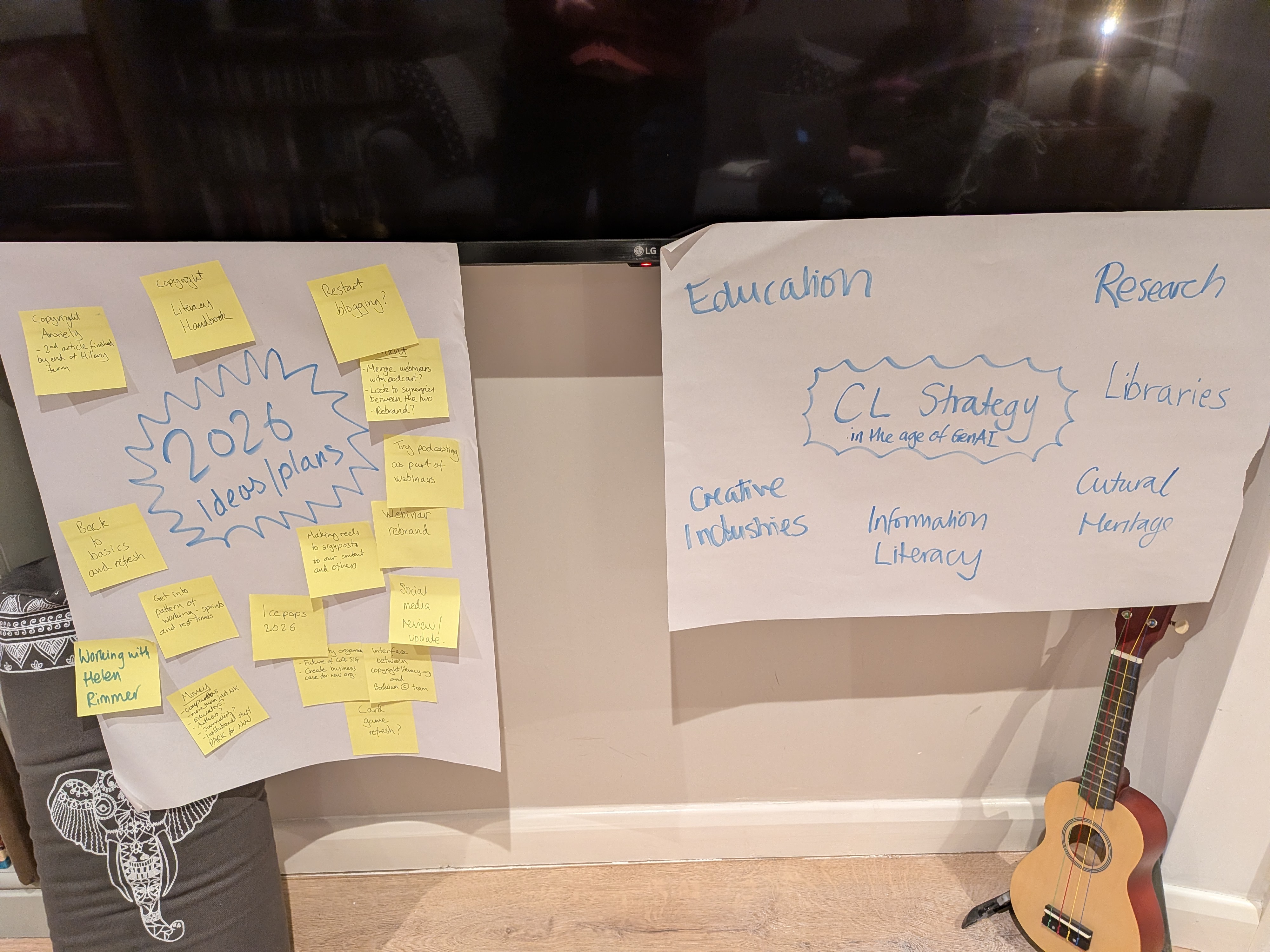
To mark the start of 2026 Chris and I had a day of planning for the year. We often used to do a annual review at the end of each year to list out the publications we had written, the conferences we had spoken at and the research we had been involved in
This year we started out by reviewing the Copyright Literacy Strategy that we put together in 2020. Although we never formally published this document, we did refer to it over the last few years to help maintain direction and moment. We realised during our planning meeting that the 5 year duration of the strategy had just expired! We took this as a great opportunity to review whether we had come close to achieving any of the goals we set ourselves and really heartening to see we had made good progress in a lot of the areas.
The strategy was divided into the following areas: our mission, our vision, our values and measures of success. We marked up the document with comments and were pleased to see that the vision we had for copyright literacy in 2025 had largely been achieved. For example, our first goal was that international organisations outside of the library profession responsible for cultural, creative and intellectual activities would recognise the value and importance of
copyright literacy. While organisations outside of the library world may have more limited understand of copyright literacy, we still felt this had been partially achieved with examples like the IFLA statement on copyright literacy issued in 2022. We also noted the growing use of the phrase ‘copyright literacy’ in numerous publications in both the library and law professions.
Our second vision was that copyright would be integrated into information and digital literacy in UK educational institutions, schools and universities. Again we felt this had been partially achieved – for example the Intellectual Property Office created some copyright education guidance for schools, and we noticed our influence on peer higher education institutions such as the University of Aberdeen and UCL.
We noted that our mission – to make copyright engaging, fun and empowering – was still valid as the fundamental basis of our work. And our values of being inclusive and evidence informed, of building a community and being creative and playful were still highly relevant.
We then turned to review our achievements in 2025, what had gone well but also some of the lessons we had learnt when things didn’t go so well. We noted that at times we had felt quite overloaded and always in ‘doing’ mode, largely because we are not good at delegating. We also often failed to monitor the impact of our work in a systemic way which sometimes meant we didn’t focus enough on activities that would really make a difference (this was largely because we were often busy doing!). But in 2020 we had listed out a series of measures of success and it felt like a key goal for 2026 should be to collect more evidence of the impact of our work so we could focus more on priorities. And we recognised we have an amazing community of copyright experts around us and we need to rely on them more and delegate more, rather than feel like we have to be leading the way all the time.
So it’s been great to look again at our strategy and start to devise a new plan for the coming 5 years, which takes us to 2031. To me that date feels like something out of a sci-fi film, and with AI advancing in the way it has in the last couple of years, who knows what that means for copyright, creativity and for humanity in general. Even though much remains uncertain, both Chris and I feel a strong sense that understanding copyright more, and questioning what it is there for, how it supports creativity, but when it acts as a blocker or barrier to furthering human knowledge is something that is going to continue to be hugely relevant for many more years. We would welcome any comments or thoughts on areas you think we should focus on in the next 5 years as we devise our new strategy, and this will be the first in a series of posts on this topic.

 Copyright Literacy