
Chris writes: We are really pleased to have a guest post from the fantastic Rachel Scanlon from the Bodleian Libraries, University of Oxford who has agreed to share her new Creative Commons Attribution Card Game on our blog. It’s an excellent resource which I know from first hand experience works really well at explaining a topic people are often confused about. Read on for the full story:
Background
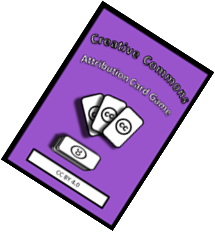
I have been teaching variations on Creative Commons Licences session for a few years. The session was originally on finding images online which included Creative Commons (CC) images. However, during the session participants asked lots of questions about CC licences and discussion of this area took a larger and larger part of the session. As my colleagues developed further sessions on Open Access and Open Scholarship it became clear that there was no session detailing Creative Commons Licences and so the old image finding session was rehauled into a Creative Commons session. Then the pandemic came and everything moved online. The content of the session migrated well and we received positive feedback from attendees but it became clear that they were having difficulty with how to attribute CC items. Attending multiple student presentations where images were attributed only as “Creative Commons image” with no other information, further motivated me to bring an element on attribution to the Creative Commons session.
In 2022 we started moving some of our training back to in-person sessions. The move back to a physical space made me think that a hands-on activity would be a useful way to teach correct attribution and being an ICEPOPS regular has converted me to using playful methods in teaching and learning. Some of you will have been lucky enough to have attended ICEPOPS in the past but for those who haven’t had the opportunity yet it refers to the International Copyright-Literacy Event with Playful Opportunities for Practitioners and Scholars. I have attended every ICEPOPS conference to date and each one has given me different ideas for teaching about copyright and licensing related material. Although, I was aware of Copyright the Card Game by Chris Morrison and Jane Secker, the thought of creating a card game of that scale was intimidating. Seeing games like Copyright Snakes and Ladders (Ruth Mallalieu) and Copyright Compliance Bingo (Caroline Salamin) at ICEPOPS showed me that I could adapt existing games I knew to use in teaching and that I could start small with a game on a particular topic.
The big idea
I knew I wanted to create a game and I new it had to cover the key elements of attribution so the next step was reviewing the Creative Commons guidance on good attribution. From the Creative Commons Organisation’s How to give attribution page and the Recommended practices for attribution wiki, it became clear that there were four key elements to a best practice attribution:
- Title
- Author/creator
- Source
- License
These elements could essentially be put together in anyway so long as all of them were used. The light bulb moment for me was realising that putting all the elements together was like creating a set in a game of cards. I could create a game with many different suits and the players would have to combine all four elements of the same suit to having a matching set and win!
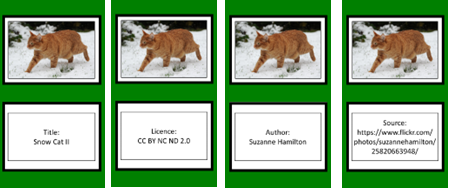
To add more of a game element I added some dud cards to the suits Date and Publisher. Working at a university most people are familiar with academic citations. They sometimes get confused between required elements of a citation and required elements of an attribution. So, I added Date and Publisher to the game to help explain the differences between academic citations and Creative Commons attribution.
I also determined that using images on the cards would be more user friendly than just text and help enforce the concept of creating a set. It was logical that the images be Creative Commons images. Thus, many important hours of work time were spent trawling through Flickr looking at adorable penguins and cute bunnies. Being able to search within a particular type of licence on the Flickr Creative Commons page and being able to filter search results to the functions of Creative Commons licences made Flickr the perfect tool for finding CC images, for this project.
Playtesting
I had the cards, I knew what my learning goals were, I just needed to design a game. As the aim was making sets I thought Gin Rummy would be a good template to work off of. Oh, how naïve I was. I had run through the theory with some colleagues but when I realised that ICEPOPS was coming up it seemed the perfect opportunity to play test the game. There would be a captive audience, who could give me live feedback after the session.
After a morning of interesting keynotes and tasty snacks, we got down to the world café where the first play test took place. It was a disaster! Gin Rummy did not suit the fast-paced game I was aiming for and getting the sets was too time consuming for the players. It was possible in the play test and it would definitely take too long with students!
So, I had to think on my feet. What’s a relatively fast paced game, where players need to create sets, where there’s a competitive element and potentially a way to share cards? I don’t know what it says about me but poker jumped to mind. I feel that the concept of community cards in poker is a useful allegory for the commons as it is a shared pool of resources that anyone can use. Using the resources does not take them away from anyone else other people can also use them and you can contribute to the resources. I had been thinking about having a shared pool of cards in some way and this seemed to work.
The new style of play was much more successful. There was still tweaking each time such as determining how many cards to put on the table, whether cards should be private or displayed on the table and how best to communicate the rules in under 2 minutes so that there was 5-6 minutes of playing time. It was as exhausting as it was fun but the feedback I received was invaluable. I would never have been able to gather such a wide pool of play testers at work. People were kind but direct in their feedback and overall, I noticed that librarians are not very competitive. The feedback led to the optional card swapping rule, which I would have never thought of.
After ICEPOPS
After calming down from all the copyright excitement at ICEPOPS I reviewed all the feedback from the play testing and determined a methodology that worked best for the game. A few of my colleagues suffered through another run through and it seemed like the game was ready to be offered to students and staff.
I already taught an optional skills session on Creative Commons licences so I tweaked the session to include the card game at the end. With excellent feedback from Chris Morrison, I renamed it “Playing in the open: Getting familiar with Creative Commons licences”. Demand wasn’t very high but we received positive feedback from those who played the game and participated in the session. They enjoyed the game and commented that they think it will help them remember how to attribute Creative Commons items.
ICEPOPS 2023
After all the play tests, changes and idea exchanges, I thought it would be useful to the ICEPOPS community to see the game in its finished form. Feedback from ICEPOPS 2022 lead me to believe that other people might be interested in my little game so I put a Creative Commons Licence on it and was ready to share.
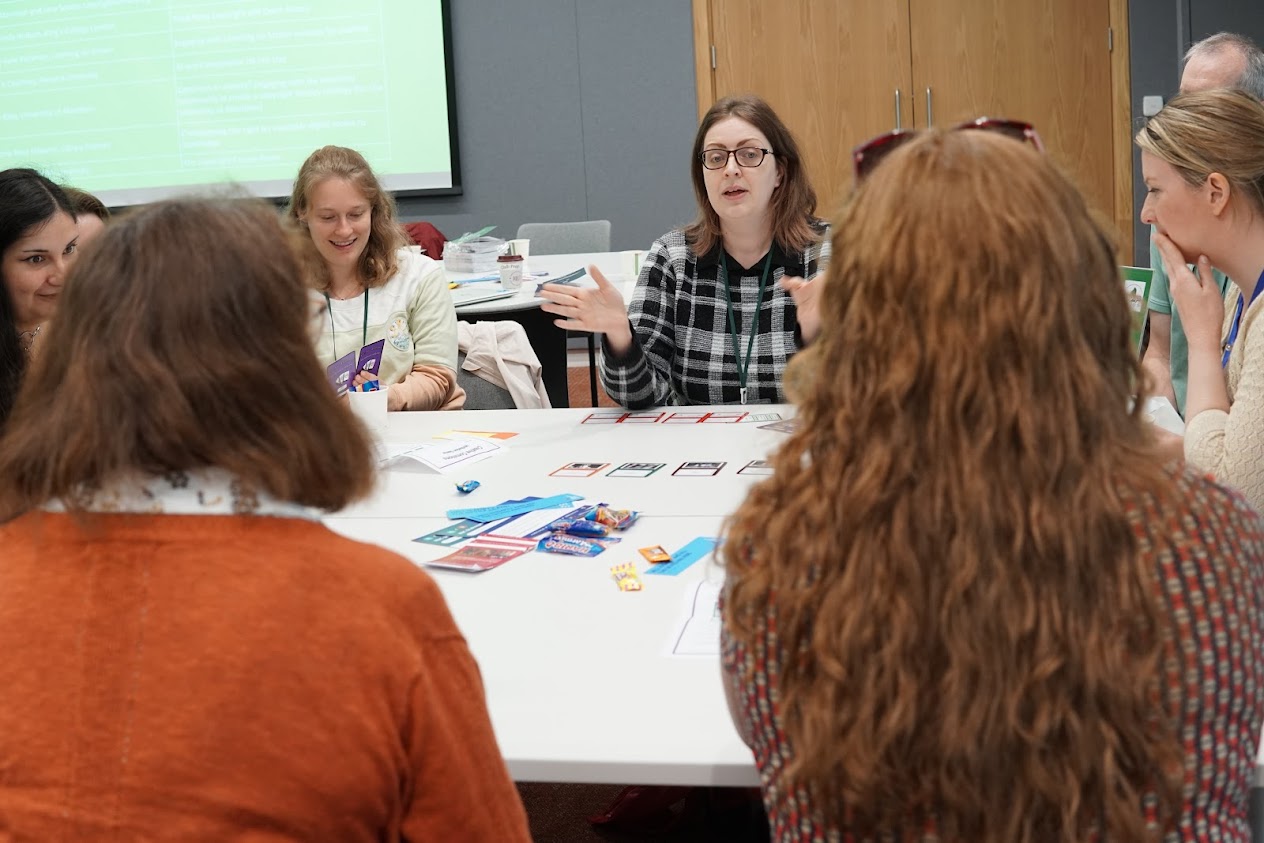
The demo went really well again at ICEPOPS. Most people enjoyed the game and I could see when the concept of the commons and getting the four key elements of attribution clicked in their heads. Some people found it difficult to pick up the rules, especially in the fast-paced environment of the World Café but it was good experience to see where their difficulties were. And to remember that not everyone will enjoy your games, and that’s okay.
Some attendees were interested in trying out the game in their institutions. I sent my draft instructions and card templates to them but I thought distributing the game to a wider audience could be useful. When I think, copyright, licensing and games I automatically think of Chris and Jane so I approached them about hosting the game on the Copyright Literacy website. And here we are. I hope some try out the game and I really hope some of you make your own changes and cards. That’s the wonderful part of it being under a Creative Commons licence, people can adapt it as much as they want. If any of you try it out or make any changes I’d love to hear about it.
Resources
Copies of the cards as PDF and PPT, instructions on how to play and a poster of rules for players are available on the Creative Commons Attribution Card Game Resources Page.

 Copyright Literacy